
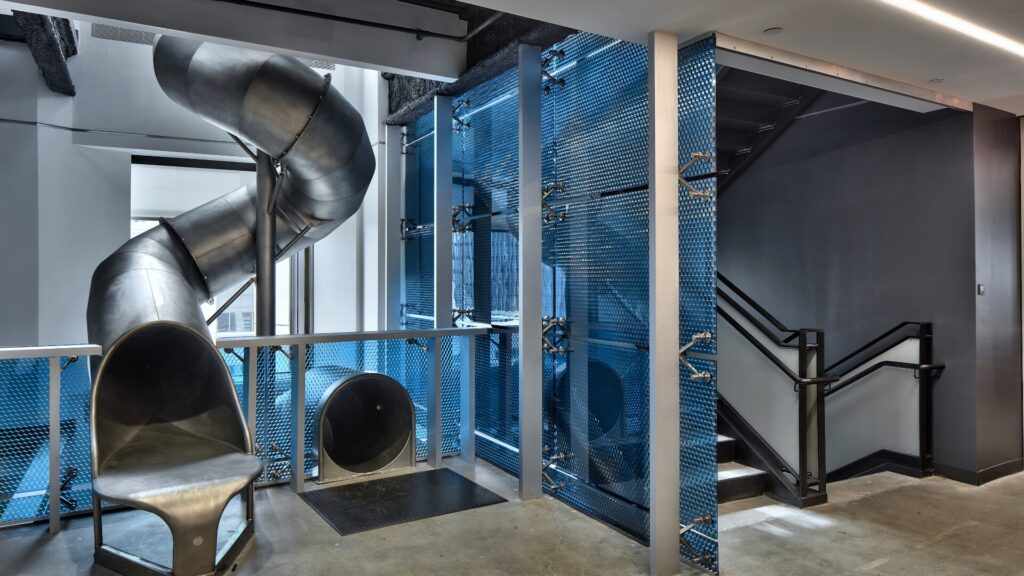
Somewhere around 2010, Silicon Valley started building playgrounds.
Slides between floors. Ping-pong tables in the center of open floor plans. Nap pods, cereal bars stocked like a kid’s birthday party, and murals on every wall. The photos circulated widely, the business press covered them with visible admiration, and the message was unmistakable: this is what a creative workplace looks like. Companies everywhere took notes.
The theory behind all of it was intuitive enough to take hold fast. Give people a space that feels energized, playful, and visually interesting, and they will generate energized, playful, and interesting ideas. For nearly two decades, organizations spent enormous money acting on that theory. But it probably didn’t work.
In a 2024 study, researchers from INSEAD and Carnegie Mellon finally put the “cool office” trope to the test. Across four experiments involving over 1,100 participants, they compared creative output in standard, neutral workspaces versus “unconventional” ones filled with bright colors and playful decor. The results were a wake-up call for companies spending millions on “inspiration-forward” design: unconventional workspaces did not reliably improve creativity. In fact, they often stifled it.
The culprit is a phenomenon known as cognitive anchoring. When a workspace is filled with specific themes or aesthetics, the mind doesn’t feel “freer”—it gets tethered to the room’s physical features.
In one experiment, participants working in a room with circular design elements produced significantly more ideas involving circles, regardless of whether a circle was the best solution. Their environment had inadvertently “primed” their brains, narrowing their focus rather than expanding it. Genuine innovation was crowded out because the office was quietly directing the brainstorm.
So what does actually drive creative performance? Decades of organizational research point to three conditions that appear consistently:
Risk permission. The belief that you can share an unfinished idea, challenge a long-held assumption, or admit you don’t know something, without it being held against you.
Freedom to decide. Real discretion over how you approach your work, not just what you’re asked to produce.
White space. Space in the week that hasn’t been pre-committed to meetings, check-ins, or someone else’s agenda.
None of these require a renovation or a capital budget. They require something considerably more demanding: consistent leadership behavior that makes them real rather than aspirational.
A room full of bean bags means very little to a team whose culture punishes wrong answers. A colorful mural makes no difference to someone who is too cautious to share an idea in a team meeting.
The most important creative infrastructure in any organization cannot be installed by an architect. It gets built, slowly and daily, by leaders who model the behaviors that make it safe to think out loud.
To your creative success…
Subscribe here to get these posts in your inbox.
If you’d like to have me speak at your upcoming event, connect here.