
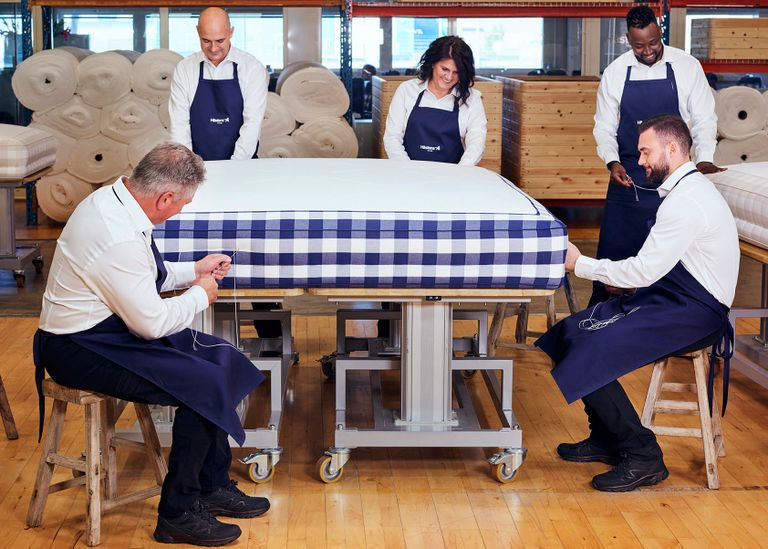
A craftsman pulls a clump of curly horsetail hair from a pile, teases it apart with his fingers like a pastry chef pulling cotton candy, and spreads it by hand over a layer of cotton and wool. At the next bench, a coworker drives an oversized needle through a side seam and pulls it tight in about 5 seconds. She spent the better part of a year learning that one stitch. Nobody in this small factory in Köping, Sweden, is in a hurry. The thing they’re building will take 600 hours to finish, and when it’s done, it will sell for more than $860,000.
It’s a mattress. For that kind of money, you could buy a Rolls-Royce, park it in your bedroom, sleep in the back seat, and still have enough left over to hire a chauffeur to tuck you in. But there’s more to it than the eye-popping price tag.
It’s called the Grand Vividus, and it’s made by Hästens, a family-owned Swedish company that started out making saddles in 1852 and has spent six generations making one extreme decision after another. Their story is a really fun example of an innovation technique I call edge-storming, which encourages taking ideas to extremes.
Saddlers in those days cushioned their work with horsetail hair. When the family moved from saddles to beds, the horsehair came along for the ride. Over the next century, the rest of the industry went the other direction. Mattresses became foam, then memory foam, then something you order online that arrives crammed into a box like freeze-dried broccoli. Hästens went to the opposite edge. They still stuff every bed with horsehair by hand, they back it with a 25-year guarantee, and if you suggest a synthetic material inside their factory, you’ll get the look you’d get for cursing in church.
Same story with the fabric. When most mattresses came in white, beige, or cream, like giant slices of Wonder Bread, they covered theirs in a bold blue-and-white check. That pattern is now so tied to the brand that visitors to the factory get picked up in a blue-check Mercedes.
Hästens already sold a bed called the Vividus for more than $400,000, which most companies would consider the edge. Then they brought in a designer to push that edge even further, more than doubling the price. The Grand Vividus is wrapped in French cowhide that’s hand-dyed in Italy and fastened with golden brass studs. The headboard is upholstered in mohair. The handles and corners are covered in stingray skin. There’s even an engraved name plate on it, made by the same people who make Olympic gold medals.
Normal brainstorming sessions don’t lead to the kind of success Hästens has had. Instead, they tend to yield incremental and rather dull ideas. We look at what we did last year and try to make it slightly cheaper or slightly faster. Personally, I’ve run plenty of those sessions, and the ideas that come out are about as exciting as a lukewarm bowl of oatmeal.
Edge-storming takes your imagination to a whole new level. Instead of asking how to make something a little better, you pick one dimension and push it as far as it will go. What would the smallest car look like? The loudest headphones? The most powerful laptop? The least expensive life insurance?
Start by isolating a single opportunity point, which could be price, client service, or a specific problem like reducing employee turnover. Then try an ideation sprint where you set aside all execution, cost, or risk factors. Simply put, you’re not allowed to share an idea unless it is extreme. Edge-storm ideas to reduce turnover might include doubling everyone’s salary or building a sand volleyball court inside the finance department.
To be clear, none of these ideas are remotely practical. But it’s far easier to push your creativity to the edge and then later ratchet those expansive ideas back to reality than to start with puny concepts that would be difficult to elevate. Sand isn’t coming to the finance department anytime soon, but the volleyball court could shrink down to a ping-pong table in the break room and a quarterly tournament with a trophy nobody wants to give back.
Every once in a while, an edge idea deserves to get built exactly as it is, stingray handles and all. A saddlemaker’s family ended up supplying the Swedish royal court and running a six-generation, $100+ million business by refusing to succumb to the gravitational force of practicality. Whatever you find at the edge of your own idea, it probably won’t be beige.
To your creative success…

Subscribe here to get these posts in your inbox.
If you’d like to have me speak at your upcoming event, connect here.