
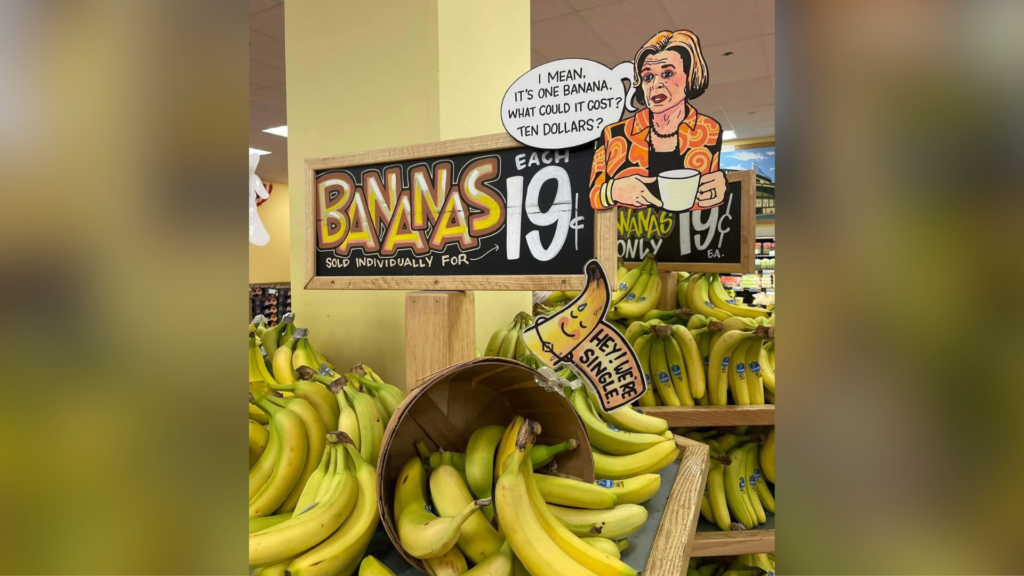
Trader Joe’s brings out the worst in my self-discipline. I show up with a carefully planned list and a goal of being in and out in ten minutes, but I abandon both halfway down the first aisle for frozen soup dumplings and a cheese I’ve never heard of. By the time I reach produce, my cart looks like it belongs to a college kid with a brand-new credit card. I round it out with a single banana, which I can do thanks to a woman I’ve never met.
Trader Joe’s stores don’t have scales, so years ago, bananas came prepackaged in bags of four or five. Dan Bane, the company’s longtime CEO, was visiting a store in Sun City, Arizona, when he watched an elderly shopper look over the bags and push her cart right past them. He asked her why. She explained that at her age, she didn’t need a whole bunch. She wanted to take life “one banana at a time.” The next day, Trader Joe’s decided to sell bananas one at a time, and it has ever since.
That shopper handed Trader Joe’s a micro-signal, a small piece of insight that reveals a preference, frustration, desire, or emerging behavior. On its own, a micro-signal can look like background noise. But when someone is paying attention, it becomes creative fodder.
In my forthcoming book, Co-Flow: The Science and Soul of Creative Collaboration, I explore the notion of Receptive Presence, an openness to truly receive, with generous attention and a willingness to be changed by what others contribute. Micro-signals are a big part of how Receptive Presence works, because shared invention doesn’t always happen in the same room at the same time. One person contributes a micro-signal that another person receives hours, weeks, or months later, and the creative chain survives only if somebody notices the signal and treats it as useful material.
Most large retailers study customers from a distance through loyalty cards, apps, and algorithms. Trader Joe’s intentionally took an analog route. Crew members get to know the regulars, and shoppers tell them which products they can’t live without and which ones they’d campaign to bring back. Individual stores then order what their neighborhoods want instead of waiting for headquarters to decide. One Atlanta location became known as “the cauliflower store” after shoppers asked for so much of it that the crew gave cauliflower products an entire freezer case.
Micro-signals are everywhere once you start listening for them. They show up when you watch a customer use your product in the wild, sit down with a person who just quit your company, follow your competitors on social media and read the comments on their posts, or ask a front-line team member what they’d do differently. The person heading out the door has nothing left to lose by telling you the truth, and a competitor’s comment section can be as revealing as eavesdropping on the next table at a dive bar.
Trader Joe’s results show that tuning in to micro-signals produces more than charming banana stories. The company tops the latest American Customer Satisfaction Index among 19 supermarket brands, a full eight points above the industry average. By most estimates, it also sells roughly twice as much per square foot as Whole Foods, while carrying only about 4,000 products and skipping online ordering entirely.
Trader Joe’s has sophisticated buyers and supply chains, of course. Yet one of its most valuable innovation technologies is a person in a Hawaiian shirt simply talking with a customer while ringing up several boxes of dark chocolate peanut butter cups.
To your creative success…

Subscribe here to get these posts in your inbox.
If you’d like to have me speak at your upcoming event, connect here.